HTTP - Static Files, MIME Types, and Encodings
Encodings and MIME types
Encodings
MIME types and bytes
1's and 0's
- The Internet can only transfer bits
- Copper: High/Low voltage
- Fiber: Light/Dark
- All data sent over the Internet must be binary
- How do we know what these 1's and 0's represent in HTTP?
- Encodings and MIME Types
Encoding Text
Text
- Only 1's and 0's can travel through the Internet
- How do we send text?
ASCII
- Character encoding
- Maps characters to numbers
- Numbers are represented in bits
- Bits are sent through the Internet
- Numbers are mapped back to characters by the receiver
- ASCII uses 7 bit encodings
ASCII Chart
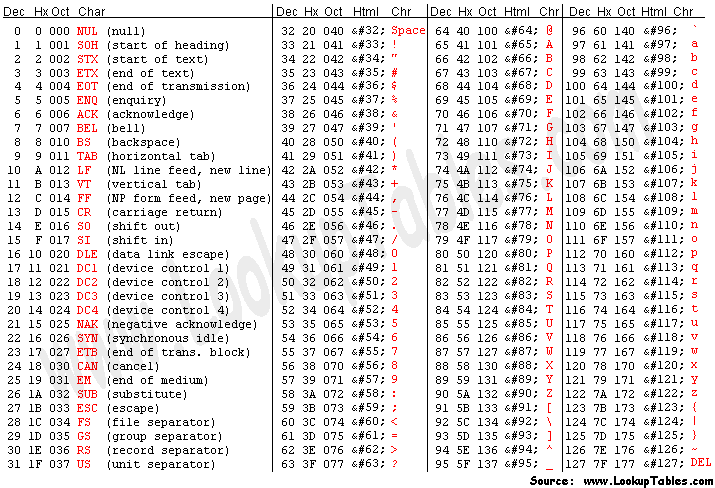
ASCII
- As a String:
- "hello"
- Programming language specific representation
- In Hex:
- 68 65 6c 6c 6f
- Need to encode the String into a byte representation
- In Binary:
- 01101000 01100101 01101100 01101100 01101111
- Send this over the Internet
HTTP Headers
HTTP Headers can only contain
ASCII characters
HTTP Headers
- When reading HTTP headers [And request/status lines]
- Assume it is text encoded using ASCII
- The body of the request/response may be encoded differently
- Read the headers to find the encoding for the body
Character Encodings
- ASCII can only encode 128 different characters
- Decent enough for english text
- Unusable for languages with different alphabets
- With the Internet, the world became much more connected
- Too restrictive for each alphabet to have its own encoding
- How do we encode more characters with a single standard?
- We need more bits!
- Enter UTF-8
UTF-8
- The modern standard for encoding text
- Uses up to 4 bytes to represent a character
- If the first bit is a 0
- One byte used. Remaining 7 bits are ASCII
- All ASCII encoded Strings are valid UTF-8
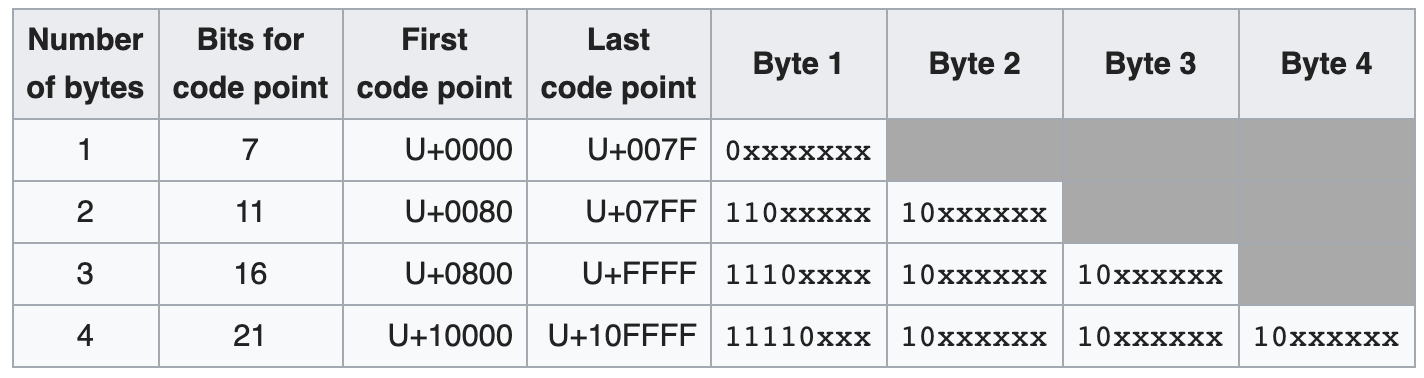
UTF-8
- If more bytes are needed:
- Lead with 1's to indicate the number of bytes
- Each continuation byte begins with 10
- Prevents decoding errors
- No character is a subsequence of another character
Sending Data
- When sending Strings over the Internet
- The Internet does not understand language-specific Strings
- Always convert to bytes/bits before sending
- Encode the String using UTF-8
- When receiving text over the Internet
- It must have been sent as bytes/bits
- Must convert to a language-specific String
- Decode the bytes using the proper encoding
Sending Data
- Use the Python methods
- .encode()
- .decode()
- You can specify the encoding as an argument of these methods
- Default is UTF-8 so providing no arguments will do what you want for this course
Content Length
- Content-Length header must be set when there is a body to a response/request
- Value is the number of bytes contained in the body
- Bytes referred to as octets in some documentation
- If all your characters are ASCII
- This is equal to the length of the String
- Any non-ASCII UTF-8 character uses >1 byte
- Cannot use the length of the String as your Content-Length!
Content Length
- To compute the content length of a UTF-8 String
- Convert to bytes first
- Get the length of the byte array
MIME Types
MIME Types
- When an HTTP response [or request] contains a body, the body is an array of bytes
- There's no restriction on the encoding used for these bytes (Cannot always assume ASCII/UTF-8)
- Set a Content-Type header to tell the browser what those bytes represent
- Tells the browser how to read the body of your response
- This is the MIME type of the data
MIME Types
- MIME type
- Multipurpose Internet Mail Extensions
- Developed for email and adopted for HTTP
- Two parts separate by a /
<type>/<subtype>
- Common types
- text - Data using a text encoding (eg. UTF-8)
- image - Raw binary of an image file
- video - Raw binary of a video
MIME Types
- Common Type/Subtypes
- text/plain
- text/html
- text/css
- text/javascript
- image/png
- image/jpeg
- video/mp4
- application/json
MIME Types
- Optional settings can be added to the Content-Type header
- Separate options by a ;
- Options are formatted as
<name>=<value>
- Content-Type: text/html; charset=utf-8
- The content is HTML encoded using UTF-8
- *You must use this to tell the browser that you are using utf-8
- Don't forget to add this exactly as it appears. One character difference will break your page
MIME Type Sniffing
- Modern browsers will "sniff" the proper MIME type of a response
- If the MIME type is not correct, the browser will "figure it out"™ and guess what type makes the most sense
- Browsers can sometimes be wrong
- Surprises when your site doesn't work with certain versions of certain browsers
- Best practice is to disable sniffing
- Set this HTTP header to tell the browser you set the correct MIME type
- X-Content-Type-Options: nosniff
MIME Type Sniffing
- X-Content-Type-Options: nosniff
- Be sure to set this header properly!
- Open the browser console
- Check the headers of your response
- Make sure this header was parsed by the browser
MIME Type Sniffing
- Security concern:
- You have a site where users can upload images
- All users can view these images
- Instead of an image, a user uploads JavaScript that steals personal data
- You set the MIME type to image/png
- The browser notices something is wrong and sniffs out the MIME type of text/javascript and runs the script
- You just got hacked!
- Solution:
- X-Content-Type-Options: nosniff
MIME Types
- With the proper MIME types set through a Content-Type header
- The browser will know how to parse and render the body of your HTTP response
- When receiving an HTTP request that contains a body
- The Content-Type will be set to let our server know the MIME type
Sending Images
Sending Images
- Sometimes we want to send data that is not text
- Use different formats depending on the data
- To send an image
- Read the bytes from the file
- Send the bytes as-is
- Content-Length is the size of the file
- Set the Content-Type to image/
<image_type>
Sending Images
- When sending images
- Since the data is already in bytes when the file is read, no need to encode/decode
- Never try to read an image file as a string
- Never try to decode the bytes of an image into a string
- An image is not encoded using UTF-8
- The bytes will not decode properly
Sending Images
- Don't overthink sending images
- Read the bytes of the file. That's the body of your response
- You may have to specify that the file should be read as a byte array since text is often assumed in File IO examples
- Set the Content-Length to the length of the byte array
- Set the appropriate MIME type in Content-Type
- Ex: to send a .png the MIME type is "image/png"